nginx2root exposes five critical nginx flaws and a Linux kernel bug that can lead to remote code execution and root access.
Xint Research has disclosed nginx2root, five distinct nginx vulnerabilities plus one Linux kernel bug, each with a proven exploit. The worst of the five, now tracked as CVE-2026-123007, lets an unauthenticated attacker run code remotely, and chaining it with the kernel bug reaches root on the host.
“This issue affects NGINX Plus or NGINX Open Source configurations that use HTTP/2. When NGINX processes undisclosed traffic, the flow control window can exceed the allowed threshold, potentially resulting in a heap buffer overflow typically followed by an NGINX worker segmentation fault. Additionally, attackers can execute code on systems with Address Space Layout Randomization (ASLR) disabled or when the attacker can bypass ASLR. (CVE-2026-123007)” reads the advisory. “An attacker could leverage this vulnerability to crash the NGINX worker process, corrupt its memory, or potentially execute code remotely. There is no control plane exposure; this is a data plane issue only.”
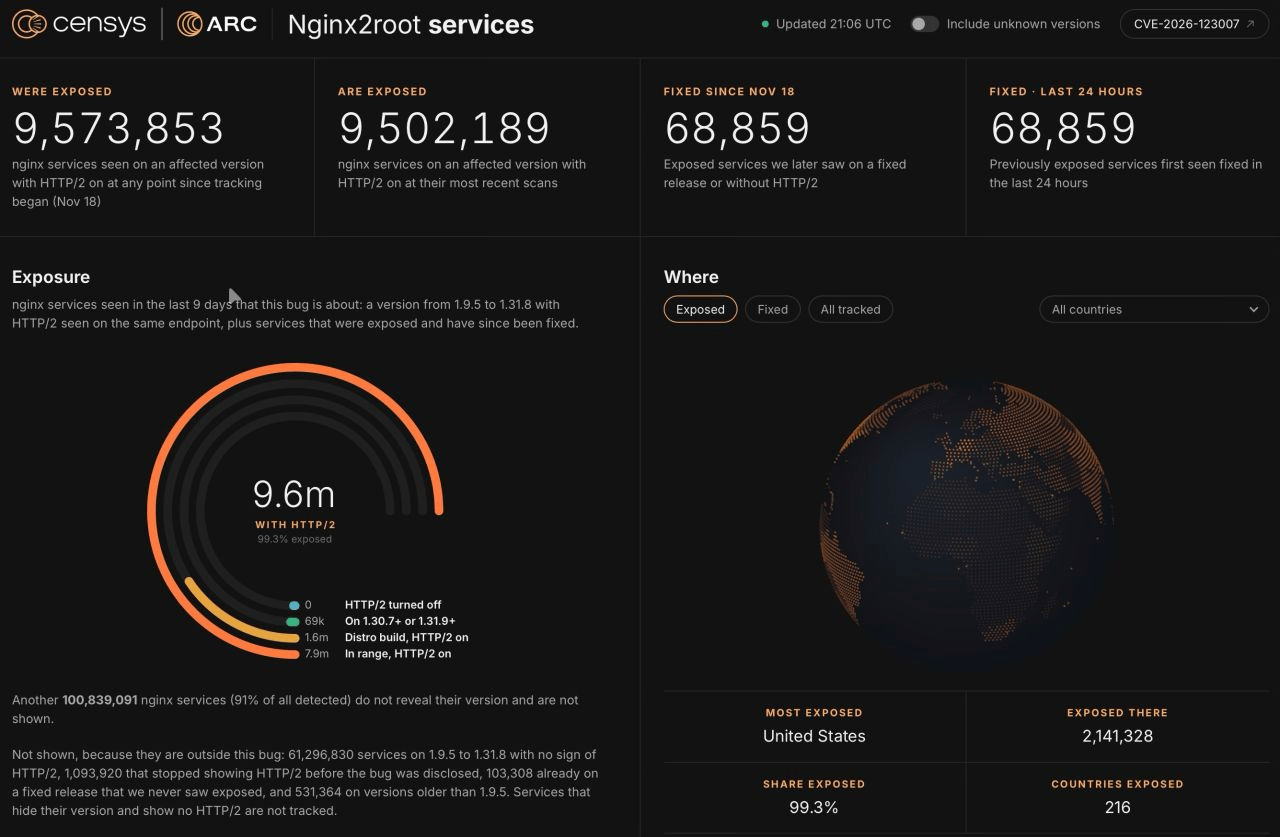
Affected nginx versions run from 1.9.5 to 1.31.8, and the fix landed in 1.31.9. According to Zakir Durumeric, Co-Founder and CEO Censys, nearly 10M Internet services are running versions of Nginx vulnerable to the NGINX2Root CVEs.
The bug sits in nginx’s HTTP/2 flow control, and it’s been there since nginx added HTTP/2 in 2015, eleven years ago. An attacker corrupts memory in an nginx worker, leaks memory addresses, and overwrites a pointer to a cleanup function that fires when a connection closes.
“Specifically, the most severe vulnerability is in nginx HTTP/2 flow control. An unauthenticated remote attacker can corrupt memory in an nginx worker, leak memory addresses, and overwrite the pointer to a cleanup function that runs when a connection closes.” reads the advisory. “This can be used to execute commands with worker privileges and receive the output over an existing connection.”
The figures show why this issue matters beyond nginx itself. In a Shodan scan on 10 November, 98.9% of nginx servers with a known version were running a vulnerable release. Xint also found that 88.6% of Fortune 500 companies use nginx. These figures show how widespread the vulnerable versions are, not how many servers can actually be attacked. Some servers may not have HTTP/2 enabled or may already include a fix provided by their software vendor. Still, administrators have a large number of systems to check.
To move from control of an nginx worker to full root access, an attacker needs to exploit a second flaw in the Linux kernel’s SCTP code. Xint tested this attack chain in environments running on AWS, GCP and Azure, including systems reachable through a public IP address. Luxembourg’s cybersecurity response team, CIRCL, also confirmed that exploiting the kernel flaw is necessary to gain root access. No active attacks have been reported so far, and CVE-2026-123007 was not on CISA’s Known Exploited Vulnerabilities catalog at the time of writing.
The discovery story is worth pausing on. nginx has been fuzzed by the best researchers for two decades, and a pre-auth RCE in it is rare, the last known one dating to 2013.
“nginx runs roughly a third of the web and has been fuzzed and audited by the best researchers in the world for two decades. Pre-auth RCE in nginx almost never happens. The best known one is from 2013. This year every AI lab pointed models at it. Everyone figured the easy bugs were long gone.” continues the advisory. “While testing a new Xint capability ahead of ZeroDay Cloud, a Xint researcher pointed it at a slice of nginx, about 50,000 lines. He picked the target; Xint did the rest. Ninety minutes later it flagged high severity issues with reproduction steps specific enough to become a working exploit in under ten minutes.”
That first find was a human picking the target and an AI doing the digging. What came next was different: Xint folded what it learned into a general feature, not tuned to nginx, and that version found the other four critical bugs with no human guidance. One of those four was also found independently by other researchers around the same time, so Xint wasn’t working in a vacuum.
Four more flaws shipped fixes in the same release, each needing its own specific setup: a backend proxy running low on connections, a proxied server name built from variables combined with certain directives, HTTP/3 turned on, or nginx running as a mail proxy.
All five vulnerabilities have a CVSS 4.0 score of 9.2 out of 10, making them critical. NGINX Plus is also affected across several release lines. The fixed versions 1.31.9 and 1.30.7 were released today, along with NGINX Plus versions 37.3.0.1 and 37.0.8.1
Check exposure with a simple test: run openssl s_client with -alpn h2 against your server, and if it answers “ALPN protocol: h2,” HTTP/2 is on. If you’re behind a CDN, test the origin directly, since an origin serving only HTTP/1.1 can’t be hit through HTTP/2 even if your CDN speaks it to visitors. Update to the fixed version and restart nginx fully, because a reload alone leaves the old binary running.
If you can’t patch right away, turn off HTTP/2 on affected listeners as a stopgap. That blocks the worst flaw and one other, but not the remaining three, so it’s a bridge, not a destination. Distribution packages can carry a backported fix without changing the version string nginx -v reports, so check your vendor’s own advisory rather than trusting that number alone.
Xint says the main value of this discovery goes beyond finding these vulnerabilities. It’s about building a process that can quickly turn the next AI-driven attack, similar to ARTEX, into security detections before attackers can take advantage of it.
Below is a video PoC of the attack:
Follow me on Twitter: @securityaffairs and Facebook and Mastodon
(SecurityAffairs – hacking, nginx2root)


