GitLab Duo Agent Platform has become more efficient in how it uses the underlying models offered through GitLab. That includes all the latest models from Anthropic, OpenAI, Google, and GitLab-hosted open-weight models.
And, we’re passing the savings to you.
Each task you give to agents and flows in GitLab now results in fewer model requests. Enable prompt caching and eligible tasks use even fewer requests. Together, these efficiencies mean most customers will see their GitLab Credits go up to twice as far.
What this looks like in real life
As a representative example, consider the following example of a real team of 500 people using GitLab Duo Agent Platform in October 2026. Across every use case, the number of requests they were billed for (Column 2) is higher than what it would be with the new efficiencies turned on (Column 4). Therefore, the GitLab Credits used moving forward (same request to credit ratios by model type) will be lower.
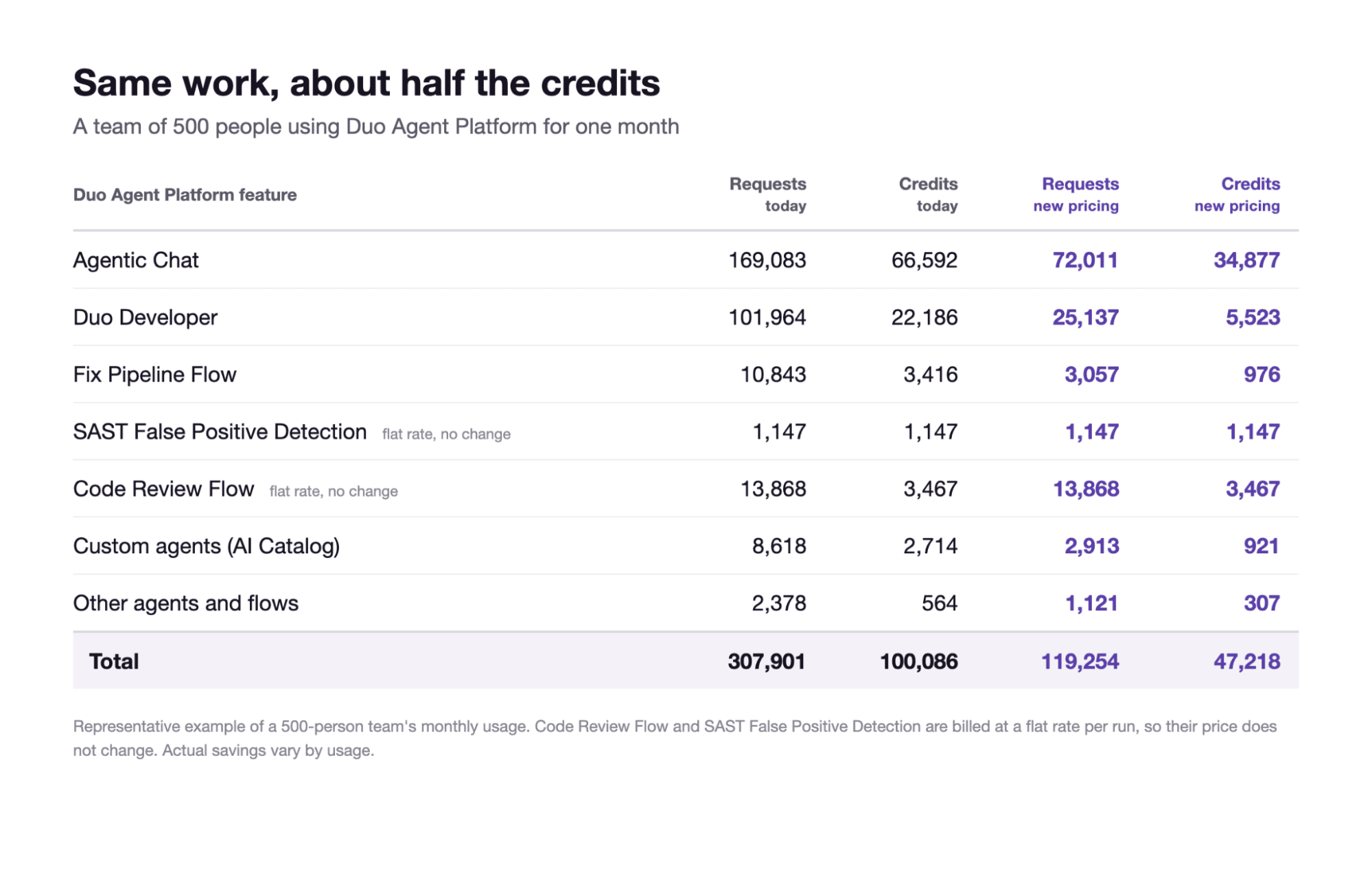
Your GitLab account team can show how your recent usage compares with the new efficiencies enabled, so you can see how much further your credits will go.
Put the extra credits to work
With fewer credits required for your current use cases, you can enable more agents and flows, and automate more steps in your software development lifecycle, natively integrated in the GitLab platform you already use. Here are some good places to start:
- Turn Slack conversations into shipped work. GitLab for Slack now has agent capabilities. Mention @GitLab in a team channel or your own DM, and the agent reads the conversation, checks what already exists in GitLab, turns decisions into issues and merge requests, and starts agent flows, posting the results back to the thread. Each request runs with your own GitLab permissions and is recorded as an agent session.
- Put routine work on a schedule. With scheduled automations, now in beta in GitLab 19.6, flows run on their own at a cadence your team sets, from every 15 minutes to every three months. Triage new issues every morning, or check CI health every hour and comment with the likely root cause before anyone opens the incident.
- Find the flaws other scanners miss. The Business Logic Security Analyzer, now in beta for GitLab Ultimate on GitLab.com, scans repositories and merge requests for authorization and access-control vulnerabilities that pattern-based scanners can miss. To power this flow with Anthropic’s Claude Mythos 5.2, contact your account team.
- Turn issues into merge requests. Duo Developer takes an issue to a ready-to-review merge request, following the issue’s plan in your project’s context. Start it from an issue or a discussion in GitLab, have it start automatically when a work item changes status, or work with it directly from the Duo CLI. Every session is recorded in GitLab. Because these sessions are long and context-heavy, they benefit most from the new efficiencies, especially with prompt caching enabled.
- Hand off a whole objective with /goal. In the Duo CLI or Duo Agent Platform Chat, describe what you want done with
/goal, and GitLab Duo plans the work, carries it out and checks the result, using an independent judge to decide when the goal is met. You stay in control throughout and can pause, change the goal, or redirect the agent at any point.
If you’re using credits as part of a GitLab Flex agreement, you can also use those freed-up credits for recently released capabilities such as GitLab Secrets Manager, Dedicated Runners, GitLab Orbit (coming soon), and more innovations.
More value, more visibility, more control over your spend
These efficiencies build on recent launches that help you see where credits go, set budget guardrails, and direct your spend as priorities change.
See where your investment is going. The Duo Agent Platform Impact dashboard, introduced in GitLab 19.5, brings adoption, work activity, and credit consumption into one view. Break down consumption by model, flow type, and group or project to inform where you expand next.
Set guardrails as adoption grows. The Credit caps page, introduced in GitLab 19.4 for GitLab.com and Self-Managed, lets you set a default per-user credit cap and individual overrides without using an API. This gives teams room to experiment while managing how much each user can consume.
Give every user visibility into their own usage. Individual users on GitLab.com can now track their own GitLab Credits consumption over time, filtered by product and date range, without relying on an administrator’s report.
Keep your budget flexible with GitLab Flex
As you discover where agents deliver the most value, your spending priorities will evolve too.
GitLab Flex brings seats and GitLab Credits together under one annual commitment, with flexibility to adjust your monthly allocation within your agreement. It helps you direct your investment toward the capabilities your teams need as adoption grows.
More value from each credit, combined with more flexibility in how you use your budget, gives you room to expand without treating every new use case as a separate investment decision.
Enable the new efficiencies in your account
The new efficiencies begin on November 19, 2026, for new customers. Existing customers can opt in any time from November 19 (opting in is a one-way move), or move by default on December 18, 2026. If you opt out before December 18, you keep your current terms and included credits until your next renewal or for 12 months, whichever comes first.
Separately, the promotional credits included with every Premium and Ultimate seat are being updated. Starting Jan 1, 2027, the promotion is changing to $8 in credits a month for Premium users and $16 in credits a month for Ultimate users.
For full details on GitLab Credits and the transition, see the GitLab Credits documentation or contact your account team.
Questions about what this means for your account? Reach out to your account team.
New to GitLab? Start a free trial of GitLab Ultimate, which includes GitLab Duo Agent Platform. No credit card required.
Flat-rate features (Code Review Flow, SAST flows, and Code Suggestions) are not affected, and self-hosted models stay at 8 requests per credit.


